I'm a big fan of Henri Nouwen. I'll read anything he writes because he writes from the heart with piercing insight. This is from his Genesee Diary written during his time in a Trappist monastery. What if our communities had this attitude and spirit about them?
"Today: The feast of St. Thomas the Apostle. During a dialogue...two of the monks remarked in differenct ways that although Thomas did not believe in the resurrection of the Lord, he kept faithful to the community of the apostles. In that community the Lord appeared to him and strengthened his faith. I find this a very profound and consoling thought. In times of doubt or unbelief, the community can 'carry you along,' so to speak; it can even offer on your behalf what you yourself overlook, and can be the context in which you may recognize the Lord again."
This leads me to ask; What if instead of ranting about correct belief, we practiced correct living?

Wednesday, August 30, 2006

Thursday, August 10, 2006
How to Die
I'm currently meditating on this passage of Scripture from John's Gospel (chapter 12) in the New Testament, which was brought to my attention by a visit to Sacred Space (amazing online prayer and meditation):
Jesus said "Very truly, I tell you, unless a grain of wheat falls into the earth and dies, it remains just a single grain; but if it dies, it bears much fruit. Those who love their life lose it, and those who hate their life in this world will keep it for eternal life. Whoever serves me must follow me, and where I am, there will my servant be also. Whoever serves me, the Father will honour."
The editors of Sacred Space make this profound and difficult insight into the passage:
"The grass sheds its seeds on the soil before it withers. The salmon swims up the stream to die. It is harder for us humans to accept the law of nature, that we too must fade away and find happiness in passing on our riches to others."
I have to admit, that's a tough invitation. But Jesus seems to be saying, hey, this is a fundamental reality of life: deal with it. Want a productive life? Die. Want to increase the happiness of the world around you? Die. Want to get at what life is actually about (as opposed to what I think it's about)? Die.
Now, "dying to self" is a concept firmly rooted in the tradition that nurtured me in my youth. And the concept goes something like this: Give God the "unknown bundle," that is, all the things you don't know you don't know before you know. But the reality is difficult. What does it mean to die to myself?
Jesus isn't talking literal death here, he's talking volitional death. Death of my will asserting itself in every one of my interactions in favor of my way over against some other way. So this is forcing me to wrestle with a whole set of questions.
How should I die? How does that work out with maintaining healthy boundaries? What does that mean for my marriage? My work? My hobbies? My interests? The way I spend my money? The things I allow to rattle around in my head? The emotions I indulge? The emotions I neglect? The thoughts I shove aside? My relationships with my superiors? My relationship to the marginalized and disenfrachised? My relationship to other religions?
This is, as Jesus understood, a core issue of life (as opposed to some minor, comparmentalized religious issue) that most people (including me) are generally never willing to confront.
Jesus said "Very truly, I tell you, unless a grain of wheat falls into the earth and dies, it remains just a single grain; but if it dies, it bears much fruit. Those who love their life lose it, and those who hate their life in this world will keep it for eternal life. Whoever serves me must follow me, and where I am, there will my servant be also. Whoever serves me, the Father will honour."
The editors of Sacred Space make this profound and difficult insight into the passage:
"The grass sheds its seeds on the soil before it withers. The salmon swims up the stream to die. It is harder for us humans to accept the law of nature, that we too must fade away and find happiness in passing on our riches to others."
I have to admit, that's a tough invitation. But Jesus seems to be saying, hey, this is a fundamental reality of life: deal with it. Want a productive life? Die. Want to increase the happiness of the world around you? Die. Want to get at what life is actually about (as opposed to what I think it's about)? Die.
Now, "dying to self" is a concept firmly rooted in the tradition that nurtured me in my youth. And the concept goes something like this: Give God the "unknown bundle," that is, all the things you don't know you don't know before you know. But the reality is difficult. What does it mean to die to myself?
Jesus isn't talking literal death here, he's talking volitional death. Death of my will asserting itself in every one of my interactions in favor of my way over against some other way. So this is forcing me to wrestle with a whole set of questions.
How should I die? How does that work out with maintaining healthy boundaries? What does that mean for my marriage? My work? My hobbies? My interests? The way I spend my money? The things I allow to rattle around in my head? The emotions I indulge? The emotions I neglect? The thoughts I shove aside? My relationships with my superiors? My relationship to the marginalized and disenfrachised? My relationship to other religions?
This is, as Jesus understood, a core issue of life (as opposed to some minor, comparmentalized religious issue) that most people (including me) are generally never willing to confront.
Wednesday, July 26, 2006
Christians Gone Wild (in cities)
Tim Keller, of Redeemer Presbyterian Church in NYC, gets it.
What the Gospel is, what it means and how we are to live it. This article (A New Kind of Urban Christian) is part of the Christian Vision Project: An attempt to reenvision the Christian faith for our day and time.
Read it.
What the Gospel is, what it means and how we are to live it. This article (A New Kind of Urban Christian) is part of the Christian Vision Project: An attempt to reenvision the Christian faith for our day and time.
Read it.
Tuesday, July 25, 2006
Church: The point
I like it simple. Not simplistic, simple.
I ran across this quote by Rob Bell that for me put the whole church-and-why-I-am-here-on-the-planet-thing in perspective. This was from an interview in a Houston paper about his everything is spiritual tour wrapping up this month.
"We are passionate about people being healed on the inside,
and we are passionate about society being healed on the outside," Bell said.
"We would call that the whole Gospel."
I ran across this quote by Rob Bell that for me put the whole church-and-why-I-am-here-on-the-planet-thing in perspective. This was from an interview in a Houston paper about his everything is spiritual tour wrapping up this month.
"We are passionate about people being healed on the inside,
and we are passionate about society being healed on the outside," Bell said.
"We would call that the whole Gospel."
Sunday, July 23, 2006
John Wesley Rides Again, Part 1 of ?
John Wesley has got to be one of the great figures in the history of the people who follow Jesus. Among other things:
- He is credited with keeping England from a civil war (as happened "across the pond").
- His life, thought, preaching and ministry was seminal in helping England abolish slavery without said civil war.
- He understood that the message of Jesus meant physical ramifications for people or it wasn't the message of Jesus. His message: "there is no holiness apart from social holiness."
- He wasn't afraid to throw-down with the big boys. The churched gentry (the power-brokers in English society) would have nothing to do with the coal miners or any other group who couldn't appropriately find their way into a church building. As a result, there was an ever widening gap between rich and poor, upper and lower class--all in the name of God, culture and social acceptability.
- In contrast, he preached (against his own preferences) outdoors to the coal miners. He had no idea he was getting through until he saw tears coming down their blackened faces.
- He made increasing amounts of money each year, but continued to live on the same amount, giving the rest away. He died with no substantial financial assets to speak of.
- He exercised regularly and was in excellent physical health into his 70's.
- He was fluent in Greek, Hebrew and Latin and required that all who served with him be the same.
- His letter writing to people needing spiritual counsel was nothing short of remarkable in its scope and breadth.
Wednesday, July 19, 2006
Single Again...for a little while
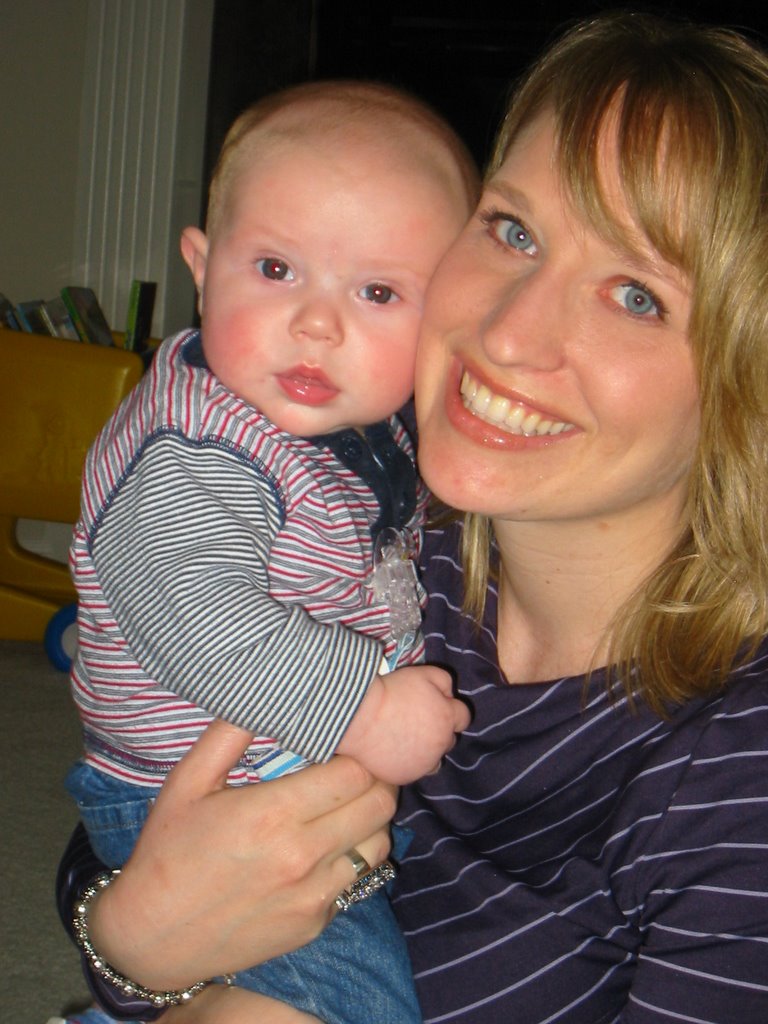
My wife if leaving me for six weeks.


It's a work thing that has great possibilities for the future. Hudson is going with her.
When she's gone, I feel like a lost puppy. And I think about the fact that many, many people live with that kind of loneliness all the time. Mother Theresa was right: loneliness is a cancer. A great chance for me to do a ridiculous amount of work though...
Monday, July 17, 2006
The (uninterpreted) Parable
We're getting ready to do a 6-week series at our church on the revolution of God.
For it, I'm putting together brief sermon recap videos for use in our Small Groups, and I;m thinking of using this parable in one of them.
It's one of my favorites from Soren Kierkegaard.
When I searched for the exact wording of it on Google, I found the parable explained away ad nauseum. I'll spare you that silliness. Which leads to a ministry take-away for me: Don't ruin something profound by your explanation of it.
There was a little town of Ducks. Every Sunday the ducks waddled out of their houses and down Main Street to their church. They waddled into the sanctuary and squatted in their proper pews. The duck choir waddled in and takes it place, then the duck minister came forward to preach.
"Ducks! God has given you wings! With wings you can fly! With wings you can mount up and soar like eagles. No walls can confine you! No fences can hold you! You have wings. God has given you wings and you can fly like birds!" All the ducks quacked their amens.
Then the ducks walked home.
For it, I'm putting together brief sermon recap videos for use in our Small Groups, and I;m thinking of using this parable in one of them.
It's one of my favorites from Soren Kierkegaard.
When I searched for the exact wording of it on Google, I found the parable explained away ad nauseum. I'll spare you that silliness. Which leads to a ministry take-away for me: Don't ruin something profound by your explanation of it.
There was a little town of Ducks. Every Sunday the ducks waddled out of their houses and down Main Street to their church. They waddled into the sanctuary and squatted in their proper pews. The duck choir waddled in and takes it place, then the duck minister came forward to preach.
"Ducks! God has given you wings! With wings you can fly! With wings you can mount up and soar like eagles. No walls can confine you! No fences can hold you! You have wings. God has given you wings and you can fly like birds!" All the ducks quacked their amens.
Then the ducks walked home.
Tuesday, May 16, 2006
Putting Things Back Together
Is it just me, or do we seem to live in "vs." culture? Red vs Blue. Liberal vs Conservative. Immigrant vs Citizen. Church vs "The Culture." Evangelicals vs Gays. Modern vs Postmodern. Seeker-Sensitive vs Emergent. Science vs Religion. Academy vs Practitioner. DaVinci Code vs naive faith.
It's an old story with a continually new title. It plays out in the news, in the church, in the home--we're never safe from "vs." culture. It's always waiting for us in the next interaction or the next decision. It's oppressive.
I'm trying to remember lately that in the middle of this, we are invited to hear a good message--a gospel--that brings people together. And the central thrust of this good message is reconciliation: with God, ourselves, the people around us, with creation itself.
So if I am a true friend of this Gospel, I will work in every setting for reconciliation, right? Kind of like the King's Men, only this time with more measured success? On the surface it seems utopian, but doesn't questioning of the status quo almost always get labeled that way?
The thoughts of two John's on the subject:
John Wesley - "If your heart is as my heart, give me your hand."
Johnny Cash - "...listen to the words that Jesus said about the road to happiness through love and charity, why you'd think he was talkin' straight to you and me."
From "The Man in Black" on the Legend of Johnny Cash album.
It's an old story with a continually new title. It plays out in the news, in the church, in the home--we're never safe from "vs." culture. It's always waiting for us in the next interaction or the next decision. It's oppressive.
I'm trying to remember lately that in the middle of this, we are invited to hear a good message--a gospel--that brings people together. And the central thrust of this good message is reconciliation: with God, ourselves, the people around us, with creation itself.
So if I am a true friend of this Gospel, I will work in every setting for reconciliation, right? Kind of like the King's Men, only this time with more measured success? On the surface it seems utopian, but doesn't questioning of the status quo almost always get labeled that way?
The thoughts of two John's on the subject:
John Wesley - "If your heart is as my heart, give me your hand."
Johnny Cash - "...listen to the words that Jesus said about the road to happiness through love and charity, why you'd think he was talkin' straight to you and me."
From "The Man in Black" on the Legend of Johnny Cash album.
Tuesday, May 09, 2006
Buzz Conference
Just returned from the inagural Buzz Conference in Washington, DC.
There were some glitches, but overall a good experience. Extreme kudos on the Film Festival.
Several takeaways for me:
1 - Get away on a regular basis. The flood of creativity and perspective is crucial.
2 - Be creative by being the church. If we are made in the image of God, then the church is to be the most creative place on earth. Isn't reflecting the Imago Dei more of a value than keen execution of strategy? (not sure I mean to imply some sort of complete dichotomy there).
3 - Go to a big city when you go to a conference. The energy, the vibe, the subway (the DC Metro is amazingly clean and efficient)--it all adds to the experience.
There were some glitches, but overall a good experience. Extreme kudos on the Film Festival.
Several takeaways for me:
1 - Get away on a regular basis. The flood of creativity and perspective is crucial.
2 - Be creative by being the church. If we are made in the image of God, then the church is to be the most creative place on earth. Isn't reflecting the Imago Dei more of a value than keen execution of strategy? (not sure I mean to imply some sort of complete dichotomy there).
3 - Go to a big city when you go to a conference. The energy, the vibe, the subway (the DC Metro is amazingly clean and efficient)--it all adds to the experience.
Spirit-Filled Spiritual Formation
Francis Schaeffer, sometime philosophical guru of Evangelicalism--and paradoxically (in my mind) a champion of the arts AND propositionalism--wrote in his excellent book True Spirituality that we eventually come full circle in terms of our understanding and practice of faith. In other words, we start out doing things for one reason (e.g., parental influence, peer pressure, church authority, etc), stop doing them because we find them oppressive, strange, irrelevant, etc, only to eventually find ourselves embracing them again, only for entirely different reasons.
Case in point for me:
The phrase "spirit-filled" has held for sometime a kind of tinny hollowness in my lexicon of meaning. It was something I wanted (for primarily emotional and social reasons) in my younger days and have since spurned because of associations--in my mind--with over-emotionalism and a destructively non-reflective group-think.
Forget for the moment its biblical origins. As is often the case, what we experience often eclipses what Scripture teaches, negating our ability to live and be spiritually formed by Scripture and the church's practice of Scripture. "Spirit-filled", "full of the spirit", et al was just such a thing for me.
Enter an epiphany.
In true Schaefferian form, however, I've come to embrace it. I've realized that the phrase "full of the spirit" denotes for the writers of Scripture that kind of person who displays and lives a fully-orbed Christlike existence. The person who is formed and being formed into the image of Christ. In other words, being "filled with the Spirit" is metaphor, is code for a person who is shot through with love, joy, kindness, patience, peace, self-control and the like. It is a reference to a certain kind of person. As John Wesley noted--the spirit-filled person is the person in which "love so fills the heart there is no room for sin."
There is still the matter of equating "spirit-filled" with "instantaneous," but far be it from me to say that couldn't happen. (It should be noted here that the other often concept often equated with "spirit-filled is "on-fire"). God can, after all, do whatever God wants.
But I don't think it necessarily follows that because God does/did something it necessarily happens/happened in an instant.
To sum up my epiphany, spirit-filled spiritual formation is essentially a redundancy. Both refer to the same process by means of the same Spirit.
Viva the spirit-filled life!
Case in point for me:
The phrase "spirit-filled" has held for sometime a kind of tinny hollowness in my lexicon of meaning. It was something I wanted (for primarily emotional and social reasons) in my younger days and have since spurned because of associations--in my mind--with over-emotionalism and a destructively non-reflective group-think.
Forget for the moment its biblical origins. As is often the case, what we experience often eclipses what Scripture teaches, negating our ability to live and be spiritually formed by Scripture and the church's practice of Scripture. "Spirit-filled", "full of the spirit", et al was just such a thing for me.
Enter an epiphany.
In true Schaefferian form, however, I've come to embrace it. I've realized that the phrase "full of the spirit" denotes for the writers of Scripture that kind of person who displays and lives a fully-orbed Christlike existence. The person who is formed and being formed into the image of Christ. In other words, being "filled with the Spirit" is metaphor, is code for a person who is shot through with love, joy, kindness, patience, peace, self-control and the like. It is a reference to a certain kind of person. As John Wesley noted--the spirit-filled person is the person in which "love so fills the heart there is no room for sin."
There is still the matter of equating "spirit-filled" with "instantaneous," but far be it from me to say that couldn't happen. (It should be noted here that the other often concept often equated with "spirit-filled is "on-fire"). God can, after all, do whatever God wants.
But I don't think it necessarily follows that because God does/did something it necessarily happens/happened in an instant.
To sum up my epiphany, spirit-filled spiritual formation is essentially a redundancy. Both refer to the same process by means of the same Spirit.
Viva the spirit-filled life!
Subscribe to:
Posts (Atom)